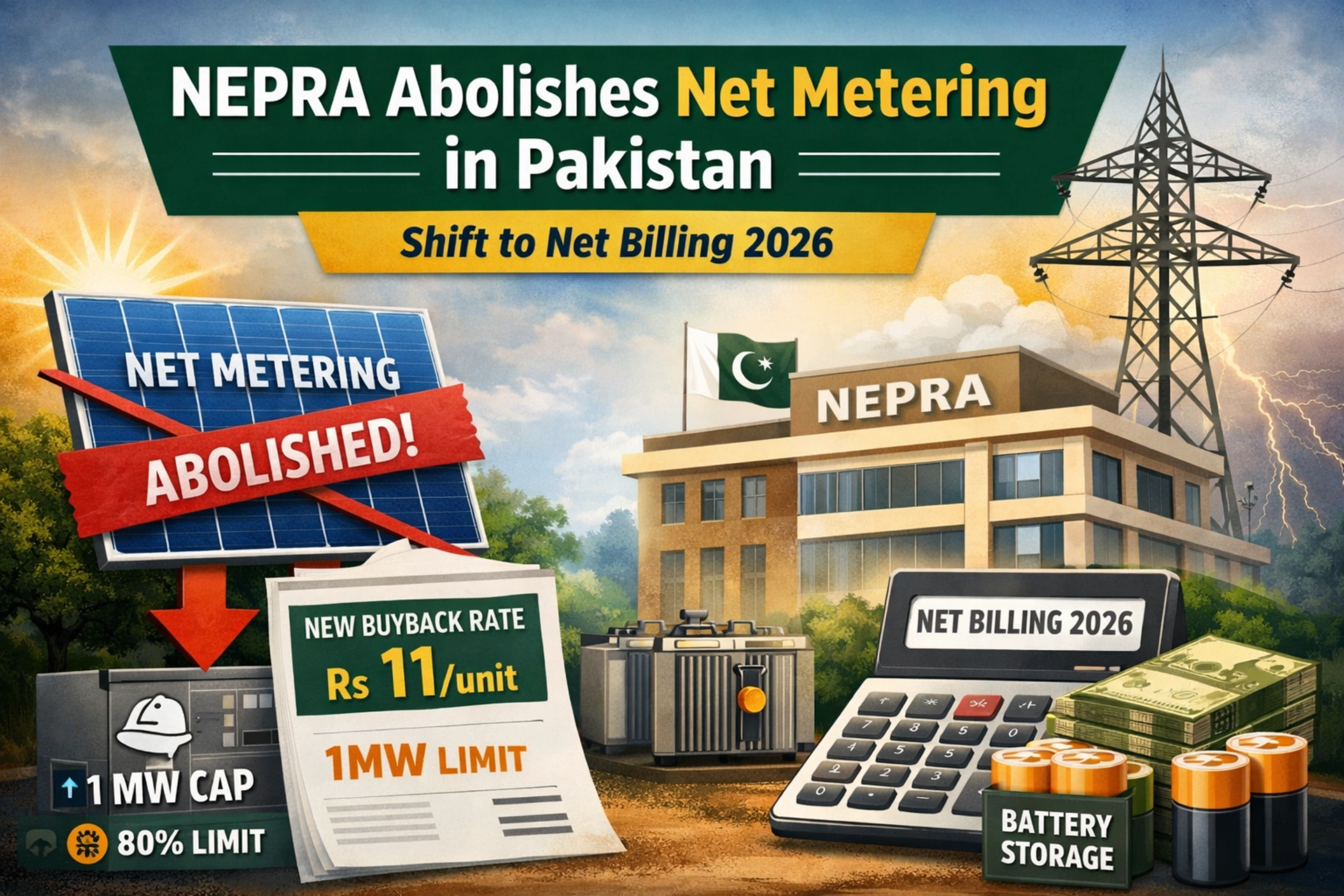
Pakistan’s solar energy sector has entered a new phase after NEPRA (National Electric Power Regulatory Authority) officially abolished the traditional net metering regime and replaced it with a new Net Billing system under the NEPRA (Prosumer) Regulations, 2026.
This decision marks one of the biggest policy changes in Pakistan’s renewable energy history and significantly changes how rooftop solar consumers are compensated.
What Has Changed?
Previously, under Net Metering:
- Imported and exported units were adjusted (one-to-one offset system)
- Consumers received credits close to retail tariff
- Agreement period was 7 years
- Export rate was around Rs25.9 per unit
Now, under the new regulations:
- Net Metering 2015 regulations are repealed
- System shifts to Net Billing
- Imported and exported units will be calculated separately
- Exported electricity will be purchased at the national average energy purchase price
- The discussed buyback rate may drop to around Rs11 per unit
- Consumers will continue buying electricity at retail rates (which may reach Rs50 per unit depending on tariff category)
- Agreement term reduced from 7 years to 5 years
What Is Net Billing?
Under Net Billing:
- Discos will purchase excess electricity from consumers at a defined purchase rate.
- Consumers will buy electricity from Discos at the applicable consumer tariff.
- There will no longer be one-to-one unit exchange.
This means the financial benefit of exporting excess solar electricity is significantly reduced compared to the previous system.
Will Existing Net Metering Consumers Be Affected?
No immediate change for existing prosumers.
- Current consumers will continue under their existing agreements until expiry.
- However, after the contract ends, renewals will fall under the new Net Billing framework.
- Discos are authorised to shift consumers to the new policy after contract expiry.
Key Technical & Regulatory Changes
The new Prosumer Regulations 2026 include several important technical conditions:
Maximum System Size
- Distributed generation facility capped at 1 Megawatt (1MW).
- System capacity cannot exceed the consumer’s sanctioned load.
Transformer Capacity Limit
- No new solar connections allowed if generation connected to a transformer reaches 80% of its rated capacity.
Load Flow Study Requirement
- Systems of 250kW or above must undergo a mandatory load flow study before approval.
Processing Timeline for Applications
Discos must:
- Acknowledge application within 5 working days
- Complete technical review within 15 days
- Install interconnection within 15 days after payment
NEPRA concurrence will be issued within 7 working days.
Financial Implications for Solar Consumers
Under the new rules:
- Export buyback rate discussed around Rs11 per unit
- Consumers may purchase electricity at rates up to Rs50 per unit
- All interconnection costs will be borne by the prosumer
- A non-refundable concurrence fee of Rs1,000 per kW has been introduced
- Metering must support two-way measurement
This significantly changes the return on investment (ROI) calculation for new solar installations.
Why Did NEPRA Abolish Net Metering?
Several reasons influenced the decision:
- Financial burden on DISCOs
- Capacity payment pressure from IPPs
- Cross-subsidy impact on non-solar consumers
- Grid stability concerns due to rapid rooftop solar growth
The regulator aims to balance financial sustainability and grid management while still allowing distributed renewable generation.
Impact on Solar Investment in Pakistan
The shift to Net Billing may:
- Increase payback period for new installations
- Reduce profitability of exporting excess units
- Encourage focus on self-consumption optimization
- Increase demand for hybrid systems and battery storage
Instead of exporting units to the grid, consumers may now prefer storing electricity for night-time use.
Net Metering vs Net Billing – Comparison
| Feature | Net Metering | Net Billing |
|---|---|---|
| Unit Adjustment | One-to-one offset | Separate import/export |
| Export Rate | ~Rs25.9/unit | Around Rs11/unit (discussed) |
| Agreement Term | 7 years | 5 years |
| ROI | Faster | Longer |
| Grid Impact | Higher financial strain | More controlled |
Broader Regulatory Powers
NEPRA has also granted itself powers to:
- Revise purchase rates during agreement life
- Demand operational data from prosumers
- Issue binding directions
- Impose penalties for non-compliance
- Modify provisions where required
Prosumers are not allowed to sell electricity to third parties using the utility network.
The Future of Solar Energy in Pakistan
Although net metering has effectively ended, solar energy remains a strong solution in Pakistan due to:
- Rising electricity tariffs
- Frequent power shortages
- Growing demand for energy independence
However, the investment strategy must now shift from export-based returns to maximizing self-consumption and storage solutions.
Conclusion
NEPRA’s abolition of net metering and introduction of the Prosumer Regulations 2026 represents a fundamental change in Pakistan’s renewable energy framework.
While the previous system offered attractive financial returns through one-to-one unit exchange, the new net billing structure focuses on financial sustainability and grid control.
Solar energy is not ending in Pakistan but the business model has changed. Consumers must now carefully evaluate system sizing, daytime usage, and battery integration before investing.
FAQ
Has NEPRA completely abolished net metering in Pakistan?
Yes. NEPRA has repealed the Net Metering Regulations 2015 and replaced them with the Prosumer Regulations 2026, shifting the system from net metering to net billing.
What is the new buyback rate for solar electricity?
The buyback rate is expected to align with the national average energy purchase price. During stakeholder discussions, a rate of around Rs11 per unit was mentioned, compared to the previous Rs25.9 per unit under net metering.
Will existing net metering consumers be affected?
No immediate change applies to existing consumers. They will continue under their current agreements until expiry. However, renewals will fall under the new net billing framework.
What is the maximum solar system size allowed under the new rules?
The maximum distributed generation facility is capped at 1MW, and system capacity cannot exceed the consumer’s sanctioned load.
What is the transformer 80% rule?
No new solar connection will be allowed if connected generation on a transformer reaches 80% of its rated capacity.
Is a load flow study required for solar systems?
Yes. Solar systems of 250kW or above must undergo a mandatory load flow study before approval.
What is the agreement period under the new net billing system?
The standard agreement term has been reduced from 7 years to 5 years, renewable by mutual consent.
Is solar still worth installing in Pakistan?
Yes, but the financial model has changed. Solar investment should now focus on self-consumption optimization and battery storage rather than exporting excess electricity.