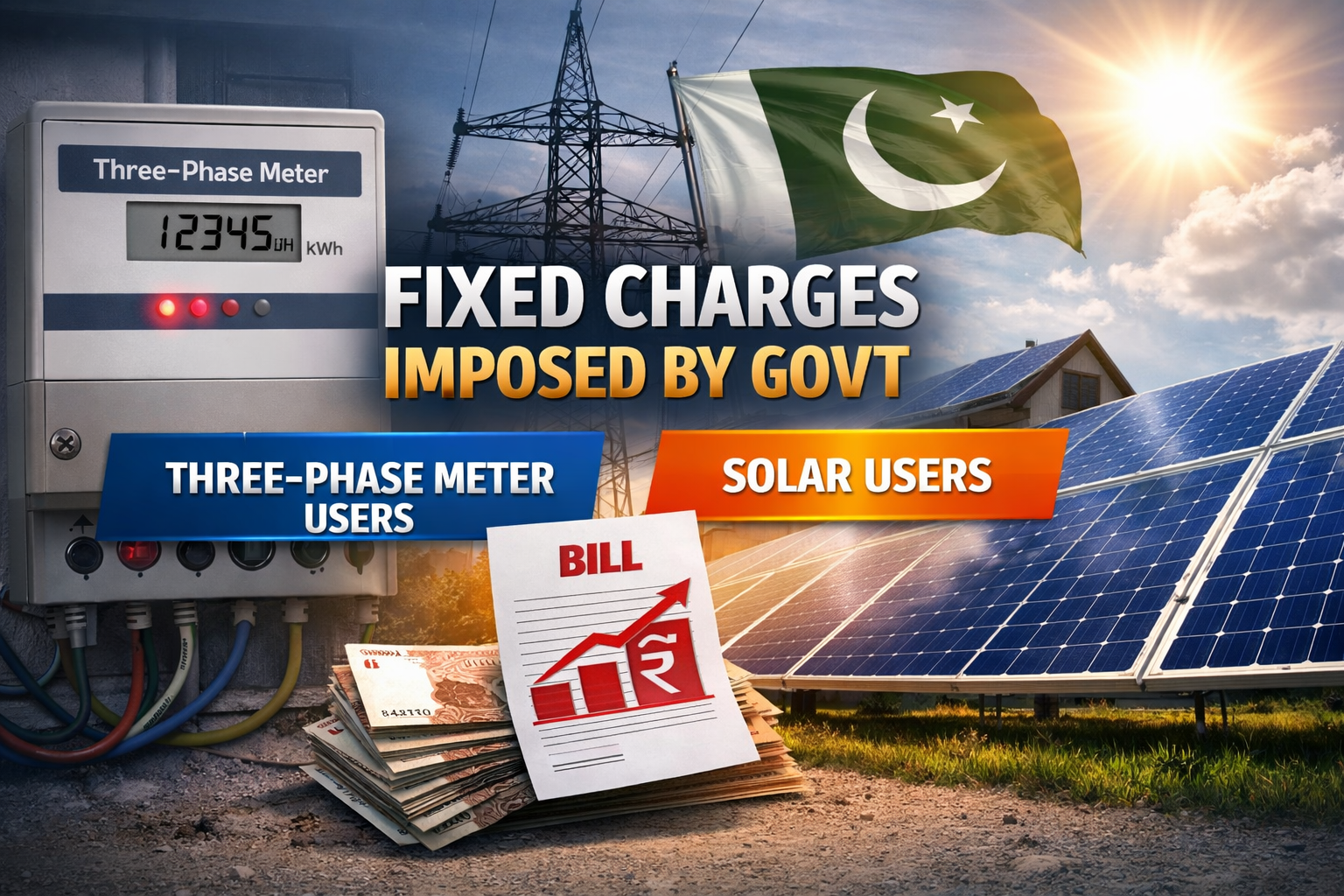
The energy sector in Pakistan continues to evolve as authorities introduce new policies to manage electricity demand and stabilize the power system. Recently, a major update has created strong discussions among consumers and solar investors. The Govt Imposes Fixed Charges on Three-Phase Meter and Solar Users, and this decision affects thousands of households, businesses, and industries across the country.
Many people installed solar systems to reduce electricity bills and gain energy independence. However, the new policy regarding Fixed Charges on Three-Phase Meter and solar connections has raised concerns about costs, savings, and long-term benefits. In this article, we explain everything about this policy, its impact on Solar Users, and what it means for people who rely on a Three-Phase Meter connection.
What It Means for Consumers
The government recently introduced additional fixed charges for electricity consumers who use Three-Phase Meter connections. At the same time, the policy also applies to many Solar Users, especially those connected to the national grid through net metering.
When authorities state that the Govt Imposes Fixed Charges, they refer to a mandatory monthly fee that consumers must pay regardless of their electricity usage. In other words, even if your electricity consumption remains low, these charges still apply.
The main goal behind this step is to ensure that electricity distribution companies recover operational and infrastructure costs. Power companies maintain transmission lines, transformers, and grid systems. Therefore, the government believes that fixed charges help cover these expenses.
However, many solar consumers argue that this move reduces the financial advantages of installing renewable energy systems.
What is a Three-Phase Meter?
Before discussing the charges, it is important to understand what a Three-Phase Meter is and why people use it.
A Three-Phase Meter is a type of electricity meter designed for properties with higher power requirements. Unlike single-phase connections, three-phase systems distribute electricity across three wires, which improves efficiency and supports heavy loads.
Typically, the following properties use three-phase connections:
Large houses with high electricity demand
Commercial buildings
Industrial units
Offices and factories
Solar systems with higher capacity
Because these properties use more electricity infrastructure, governments often apply different tariff structures and service charges.
Impact on Solar Users
The biggest debate revolves around the effect of this policy on Solar Users. Many homeowners and businesses installed solar panels to reduce electricity bills and protect themselves from rising energy prices.
However, when the Govt Imposes Fixed Charges, solar consumers may experience changes in their financial savings.
Here are some possible impacts:
Slight increase in monthly electricity bills
Longer return-on-investment period for solar systems
Reduced net metering benefits in some cases
Higher operational costs for businesses using solar
Despite these concerns, solar energy still remains one of the most reliable long-term solutions for reducing electricity costs.
Govt Fixed Charges for Three-Phase Meter – Monthly Rates by Load (5kW to 30kW)
The government has introduced fixed monthly charges for consumers using a Three-Phase Meter. These charges depend on the electricity load capacity connected to the meter.
| Load Capacity | Monthly Fixed Charges |
| 5 kW Load | Rs. 1,687 per month |
| 7 kW Load | Rs. 2,363 per month |
| 9 kW Load | Rs. 3,038 per month |
| 12 kW Load | Rs. 4,050 per month |
| 15 kW Load | Rs. 5,062 per month |
| 20 kW Load | Rs. 6,750 per month |
| 30 kW Load | Rs. 10,125 per month |
Note: These fixed charges apply regardless of electricity consumption and affect both Three-Phase Meter consumers and many Solar Users connected to the grid.
Fixed Charges on Three-Phase Meter Explained
The newly introduced Fixed Charges on Three-Phase Meter represent a mandatory monthly fee. Consumers must pay this amount regardless of how much electricity they use.
For example, even if a property generates most of its electricity through solar panels, the fixed charge still applies.
This means:
Your bill may include a base service fee
Grid connection costs remain active
Solar generation does not remove these charges
Therefore, understanding the complete billing structure becomes essential for electricity consumers.
Why Solar Energy Still Makes Sense
Although the Govt Imposes Fixed Charges on Three-Phase Meter and Solar Users, solar power still offers significant financial and environmental advantages.
In fact, solar technology continues to grow because of its long-term benefits.
Some key reasons include:
Reduced dependency on expensive grid electricity
Protection against future tariff increases
Clean and renewable energy production
Increased property value
Lower carbon footprint
Even with fixed charges, solar systems can significantly reduce electricity consumption from the grid.
How Solar Companies Are Responding
Solar companies and energy experts now focus on optimizing solar system performance to maintain maximum savings for consumers.
Companies like Scope Solar help customers design efficient solar solutions that reduce grid reliance. For example, experts recommend hybrid solar systems, battery storage, and advanced energy management strategies.
As a result, homeowners and businesses can continue to enjoy long-term savings despite new regulations.
Tips for Solar Users to Manage Costs
If you currently own a solar system or plan to install one, several strategies can help manage the impact of fixed charges.
Consider the following tips:
Choose the correct solar system capacity
Install high-efficiency solar panels
Use energy-efficient appliances
Monitor electricity consumption regularly
Consider battery storage for night usage
By optimizing your solar setup, you can reduce reliance on the grid and maintain strong financial benefits.
The Future of Solar Energy in Pakistan
Pakistan continues to face energy challenges, including high electricity tariffs and power shortages. As a result, renewable energy solutions like solar power remain critical for the country’s energy future.
Even though the Govt Imposes Fixed Charges, experts believe solar adoption will continue growing. Rising electricity prices make solar systems attractive for both residential and commercial consumers.
Furthermore, technological improvements continue to lower solar installation costs, which encourages more people to invest in renewable energy.
Companies like Scope Solar play an important role in spreading awareness and helping consumers transition toward sustainable energy solutions.
Final Thoughts
The announcement that the Govt Imposes Fixed Charges on Three-Phase Meter and Solar Users has created significant discussion across Pakistan. While the policy aims to support grid infrastructure and recover operational costs, it also affects the financial expectations of many solar investors.
However, solar energy still remains one of the most effective ways to reduce electricity expenses and ensure energy independence. Even with Fixed Charges on Three-Phase Meter, solar systems continue to deliver long-term savings, environmental benefits, and reliable energy production.
Consumers should focus on optimizing their solar setups and understanding electricity policies to make informed decisions. With the right guidance from professionals like Scope Solar, homeowners and businesses can continue benefiting from solar power while adapting to new regulations.
FAQs
Why does the government impose fixed charges on three-phase meter connections?
The government introduces fixed charges to cover grid maintenance, infrastructure costs, and operational expenses of electricity distribution companies.
Do solar users also have to pay fixed charges?
Yes, many solar users connected to the national grid may still pay fixed charges because they rely on the grid for backup electricity.
Will this policy reduce solar savings?
The policy may slightly reduce monthly savings. However, solar systems still provide significant long-term financial benefits.
What is the advantage of a three-phase meter?
A three-phase meter supports higher electricity loads and improves power distribution efficiency for large homes, businesses, and industries.
Should people still invest in solar energy?
Yes, solar energy remains a smart investment because it reduces grid electricity usage and protects consumers from rising electricity tariffs.