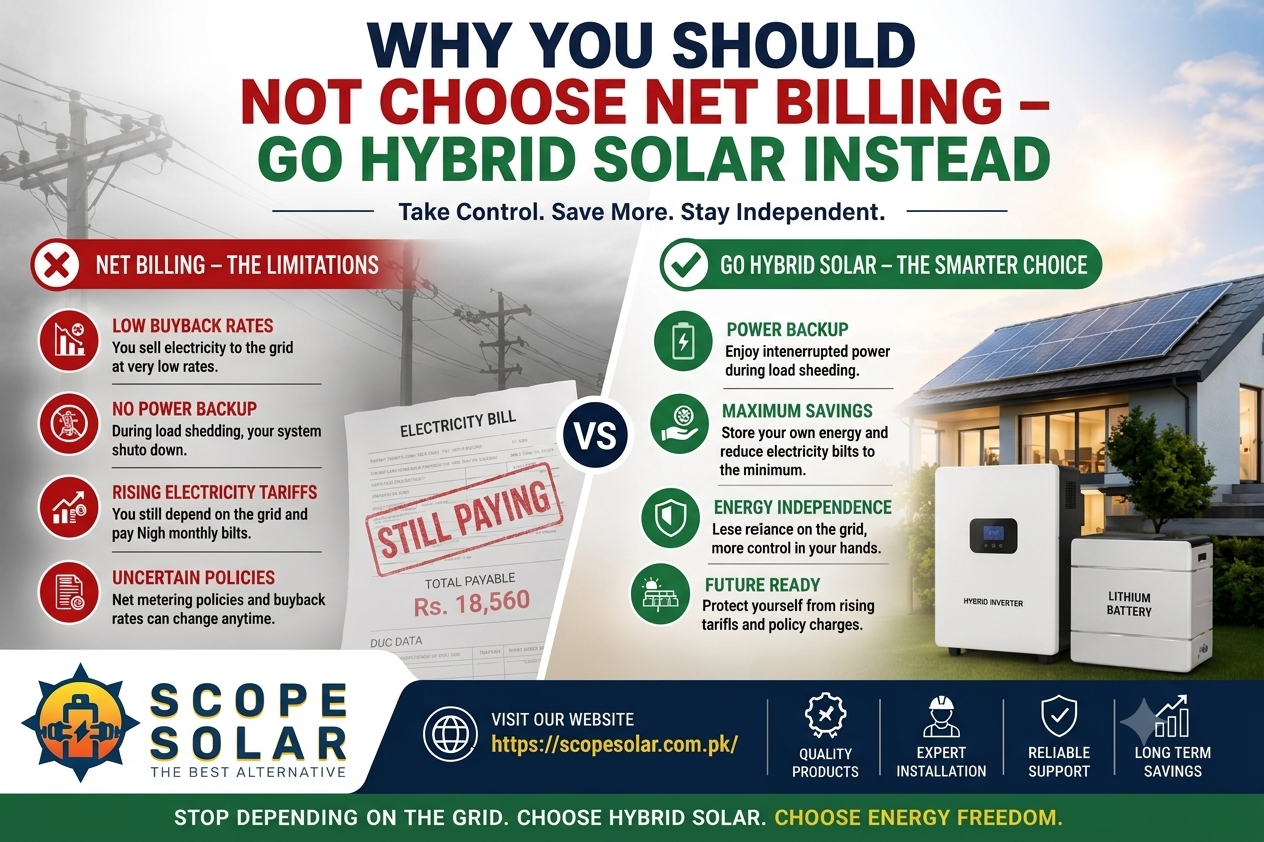
Pakistan’s solar market has changed completely. On-grid solar systems are no longer a viable option. The shift is not a trend – it is a permanent change driven by NEPRA’s new Prosumer Regulations and the economic reality every solar user now faces.
If you are still considering a basic solar setup that depends on exporting electricity to the grid under Net Billing, you need to understand what that decision actually costs you every single month.
In this guide by Scope Solar, we explain exactly why Net Billing does not work for homeowners and businesses in 2026 – and why a Hybrid Solar System is the only investment that makes financial sense today.
What Is Net Billing – And Why Did It Replace On-Grid Solar?
Pakistan previously had an on-grid solar system model where users connected their panels directly to the national grid. That model has now been discontinued for new connections. NEPRA’s updated Prosumer Regulations introduced Net Billing as the new framework.
Under Net Billing, the pricing structure is completely separate for what you sell versus what you buy:
• You sell excess electricity to the grid at Rs. 10 to Rs. 13 per unit
• You buy electricity from the grid at Rs. 22 to Rs. 44 per unit depending on your slab
• The gap between these two rates is over 60 percent
Key point: Every unit you export under Net Billing is a financial loss. You are selling cheap electricity to the same grid that charges you a premium to buy it back.
5 Reasons Net Billing Will Hurt Your Solar Investment
1. The Export Rate Is Not Worth It
The buyback rate under Net Billing is set at Rs. 10 to Rs. 13 per unit. Before policy changes, producers received significantly better returns on exported electricity. That era is over.
The more surplus your panels generate, the more money you lose by exporting it at this low rate. A larger system does not mean better savings under Net Billing – it often means bigger losses on exports.
2. Policy Can Change Again at Any Time
NEPRA has already demonstrated that it can revise export rates and billing structures. New Net Billing contracts come with a cap of just 5 years and no guarantee of renewal at current terms. Depending entirely on a policy that has already changed once is a serious financial risk.
3. No Electricity at Night – Ever
A Net Billing system has no battery storage. When the sun sets, you are completely dependent on WAPDA’s grid. Evening hours are typically when electricity consumption peaks in Pakistani households – cooking, cooling, lighting, appliances – and Net Billing gives you zero solar benefit during this time.
4. Load Shedding Shuts Your System Down
This is one of the most practical problems for Pakistani consumers. A grid-tied system automatically shuts off when the national grid goes down – it is a mandatory safety requirement. With 4 to 8 hours of daily load shedding across many areas, that means hours of wasted solar capacity every single day.
Your panels may be generating electricity in full sunlight, but if the grid is down, you get nothing from them.
5. You Only Use 30 to 40 Percent of Your Own Solar
Without battery storage, a typical household can only self-consume 30 to 40 percent of the electricity its panels generate. The remaining 60 to 70 percent gets exported at the lowest possible rate. The majority of your solar investment is effectively subsidising the grid – at a direct financial loss to you.
Net Billing vs Hybrid Solar – Side by Side
Here is how the two systems compare across the factors that matter most for Pakistani consumers:
| Feature | Net Billing System | Hybrid Solar System |
| Backup During Load Shedding | ❌ No – system shuts off | ✅ Yes – batteries keep you running |
| Electricity at Night | ❌ 100% from WAPDA grid | ✅ Stored solar from your own batteries |
| Protection from Tariff Hikes | ❌ Fully exposed to rate increases | ✅ Strong – self-consume more, buy less |
| Self-Consumption Rate | 30–40% of your solar | 70–90% of your solar |
| Export Rate You Earn | Rs. 10–13 per unit only | Minimal exports – saves at full tariff value |
| Policy Risk | High – rates can change again | Low – independent of export policies |
| Monthly Bill Savings | Moderate | 60–70% average savings |
| Payback Period | 7–10 years (under new rates) | 3–5 years |
Why a Hybrid Solar System Is the Right Choice in 2026
A Hybrid Solar System combines solar panels, a battery bank, and grid connectivity into one smart setup. The logic is simple: use your own solar first, store what is left in batteries for evening and nighttime use, and only send genuine surplus to the grid.
This one change flips the entire financial equation.
Power Through the Night
Daytime solar charges your batteries. You run on your own stored energy in the evening when grid rates are highest. No more paying Rs. 35 to Rs. 44 per unit just to watch television after sunset.
Load Shedding Becomes Irrelevant
Batteries and panels keep your home or business running even when the grid is down. Switching is seamless and automatic. Businesses, home offices, and essential appliances stay uninterrupted regardless of grid status.
Self-Consumption Jumps to 70–90 Percent
Storage means almost everything you generate gets used at home – at full value. You export far less, so the low Net Billing buyback rate barely affects you. Your solar investment works entirely in your favour.
Protection from Rising Tariffs
Pakistan’s electricity rates have been rising consistently year on year. Every unit you avoid buying from the grid saves you at the full tariff rate. As grid prices continue climbing, a hybrid system’s shield becomes more valuable every year.
The Numbers – What Hybrid Solar Actually Delivers
| Metric | Figure |
| Export rate under Net Billing | Rs. 10–13 per unit |
| Import rate from grid (your bill) | Rs. 22–44 per unit |
| Gap between sell & buy rate | Over 60% |
| Hybrid system payback period | 3–5 years |
| Average monthly bill savings (hybrid) | 60–70% |
| 5kW hybrid system price range | Rs. 9,00,000 – Rs. 13,00,000 |
| Battery storage imported in Pakistan (2024) | 1.25 GWh |
A Real-World Example
Consider a household generating 20 units per day from solar. Under Net Billing, 8 units get used during the day and 12 units are exported at Rs. 10 – earning Rs. 120. That same evening, the household pulls 10 units from the grid at Rs. 35 – paying Rs. 350. Net result: Rs. 230 out of pocket in a single evening.
With a hybrid system, those 12 surplus units charge the battery. That evening the house runs on stored solar. Cost: Rs. 0. The daily difference is Rs. 230. Over a full year that compounds into savings no export credit under Net Billing can match.
What About the Higher Upfront Cost?
A 5kW hybrid system in Pakistan currently costs between Rs. 9,00,000 and Rs. 13,00,000 – roughly Rs. 2,00,000 to Rs. 4,00,000 more than a basic grid-tied setup.
But this is a 20 to 25-year investment. The additional upfront cost pays for:
• Electricity at night from your own stored solar
• Uninterrupted power during load shedding
• 60 to 70 percent reduction in monthly electricity bills
• Protection against future tariff increases
• Independence from policy changes that affect export rates
A system that cannot run at night, shuts off during load shedding, and sells your surplus at a 60% discount will cost you far more over its lifetime than the difference in upfront price. The maths only points one way.
Is Hybrid Solar Right for Commercial and Industrial Users Too?
Yes – and often even more so. Commercial users typically consume large amounts of electricity during both daytime and evening hours. Load shedding creates direct financial losses through downtime, spoiled inventory, and missed productivity.
Hybrid systems help commercial users:
• Cut operational electricity costs by 60 percent or more
• Eliminate downtime during grid failures
• Control peak electricity consumption
• Stabilise energy costs independent of tariff changes
• Deliver faster return on investment than residential users
Factories, offices, schools, hospitals, and commercial centres across Pakistan are rapidly adopting hybrid technology for exactly these reasons.
Choosing the Right Hybrid Solar Partner
The quality of your hybrid solar system depends significantly on the company that designs, supplies, and installs it. A properly sized and installed hybrid system performs very differently from an undersized or poorly configured one.
When selecting a solar company, verify:
• Experience specifically in hybrid system design and installation
• Quality and brand reputation of panels, inverters, and batteries
• Accurate load calculation – not a generic estimate
• Warranty coverage on all major components
• After-sales service and maintenance support
Scope Solar provides advanced hybrid solar solutions for residential, commercial, and industrial users across Pakistan. Every system is designed according to actual load requirements, local grid conditions, and long-term energy goals.
Final Word
Net Billing has not ended solar in Pakistan – it has simply changed what smart solar looks like. The homeowners and businesses saving 60 to 70 percent on their electricity bills today are not the ones with the biggest grid-connected systems. They are the ones who chose hybrid, sized their batteries correctly, and stopped handing cheap electricity back to a grid that charges them a premium to buy it back.
If you want maximum savings, uninterrupted electricity, and a solar investment that is protected from future policy changes, a Hybrid Solar System is the only logical choice in Pakistan in 2026.
Frequently Asked Questions
Why are on-grid solar systems no longer a good option in Pakistan?
Under NEPRA’s current regulations, on-grid systems export electricity at Rs. 10 to Rs. 13 per unit while you continue paying Rs. 22 to Rs. 44 per unit for grid electricity. They also shut down during load shedding and provide no power at night. The financial case for purely grid-tied solar no longer works.
What makes a hybrid solar system different?
A hybrid system adds battery storage to your solar panels. Instead of exporting surplus electricity at a low rate, you store it and use it yourself at night or during outages. This dramatically increases your self-consumption rate and the value you get from every unit generated.
Is a hybrid system worth the higher upfront cost?
Yes. The payback period for a hybrid system is typically 3 to 5 years, after which your savings compound over the remaining 15 to 20 years of system life. The higher upfront cost delivers a much stronger financial return than a cheaper system that cannot operate at night or during load shedding.
Can a hybrid system handle load shedding?
Yes. Hybrid systems automatically switch to battery power when the grid goes down. Your home or business continues running without interruption, regardless of load shedding duration.
How do I know what size hybrid system I need?
A proper load assessment by an experienced solar company is essential. Scope Solar conducts accurate load calculations for every installation to ensure the panel capacity, battery size, and inverter rating are matched to your actual consumption patterns.