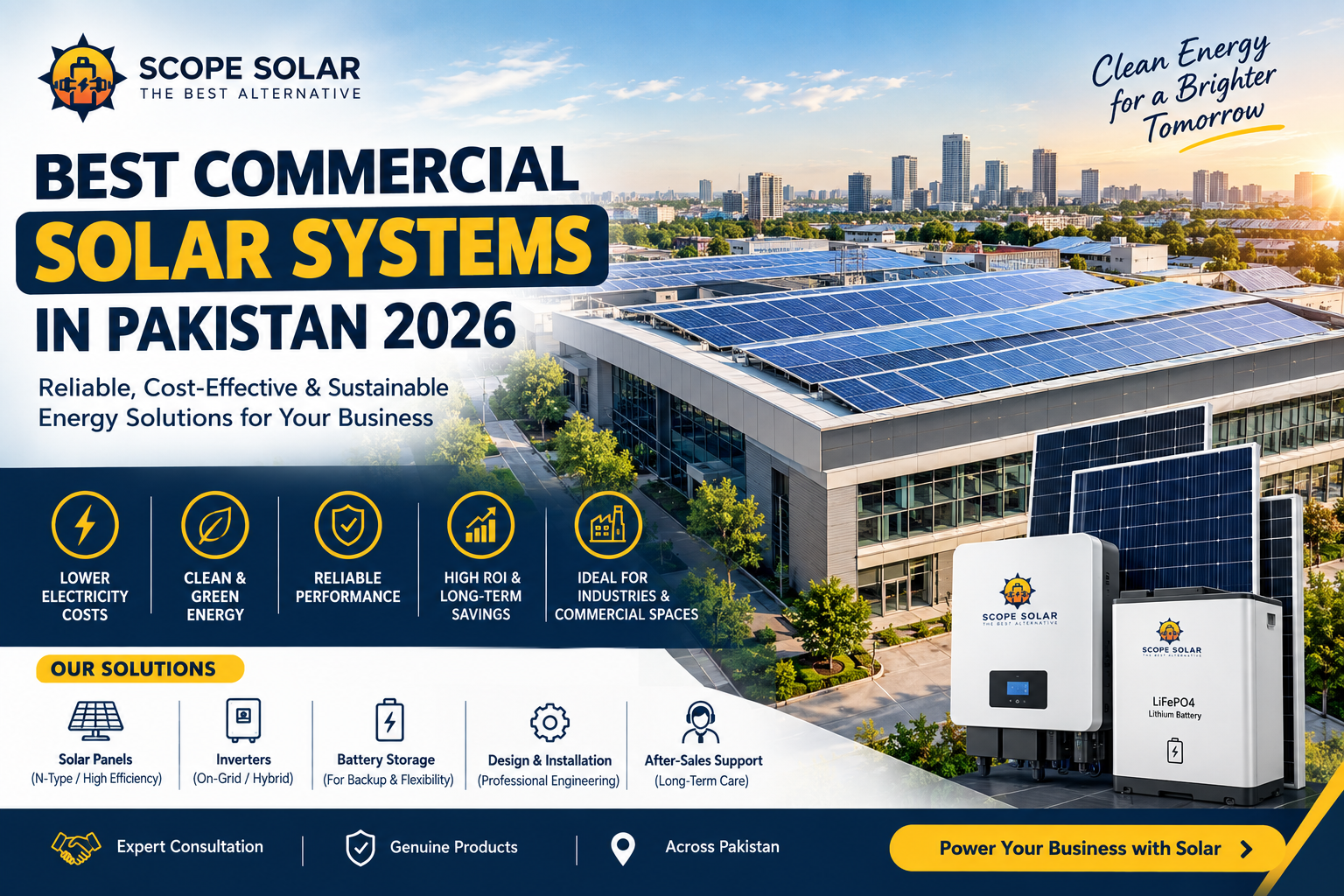
Electricity has become one of the biggest operating expenses for many businesses in Pakistan. From offices and retail stores to factories, warehouses, hospitals, schools and large commercial buildings, businesses need reliable energy solutions that can support daily operations while helping them control long-term electricity costs.
However, choosing a commercial solar system is no longer just about installing the maximum number of solar panels on a rooftop. Businesses now need to consider their daytime electricity consumption, load profile, available installation space, equipment quality, future expansion plans, battery requirements and overall return on investment.
Pakistan’s solar market is also continuing to evolve. In April 2026, the Competition Commission of Pakistan highlighted the need for better market transparency, stronger quality standards, improved infrastructure and clearer policies to support sustainable growth in the solar sector.
For businesses, this means that choosing the right solar partner and system design is more important than ever.
This guide explains how to choose the Best Commercial Solar Systems in Pakistan in 2026, the latest technologies available and the factors businesses should consider before investing.
Latest Commercial Solar Technologies in 2026
Solar technology has improved significantly and commercial customers now have access to more advanced equipment.
High-Efficiency N-Type Solar Panels
N-Type solar panels have become increasingly common in new installations. Technologies such as TOPCon offer higher efficiency and improved performance compared with many older-generation modules.
For commercial buildings with limited rooftop space, higher-efficiency panels can be particularly useful because they allow businesses to install more generating capacity within the available area.
The latest market reports also indicate that TOPCon N-Type technology has become a mainstream option for new solar installations in Pakistan.
When choosing solar panels, businesses should consider:
- Panel efficiency
- Temperature performance
- Manufacturer warranty
- Product authenticity
- Long-term degradation
- Compatibility with the complete system design
A higher wattage number alone does not determine whether a panel is the right choice.
Smart Commercial Solar Inverters
The inverter is one of the most important components of a commercial solar system.
It converts the electricity generated by solar panels into usable power and helps manage system performance.
Modern commercial inverters can offer features such as:
- Multiple MPPTs
- Advanced monitoring
- Remote system diagnostics
- Higher conversion efficiency
- Three-phase compatibility
- Expandable system architecture
- Integration with energy storage
Businesses should select inverter capacity according to their solar array, electrical infrastructure and future expansion requirements.
The 2026 market continues to offer a wide range of inverter options, with final prices varying significantly according to capacity, phase, features, brand, warranty and exchange-rate conditions.
Battery Energy Storage
Battery storage is becoming an increasingly important consideration for commercial customers.
Not every business needs a large battery bank. However, battery storage can be valuable for companies that require backup for critical equipment or want greater flexibility in how they manage their energy.
A commercial battery system can potentially support:
- Critical loads
- IT equipment
- Emergency lighting
- Selected machinery
- Security systems
- Refrigeration
- Communication systems
The correct battery capacity should be based on the actual backup requirement.
Installing unnecessary battery capacity can significantly increase the project’s initial cost. Therefore, businesses should identify essential loads before deciding on a storage system.
Why Are Commercial Solar Systems Becoming More Popular?
Commercial buildings often consume a large amount of electricity during the daytime. Offices, factories, educational institutions, retail stores, warehouses and other businesses may operate for several hours while solar panels are producing electricity.
This creates a strong opportunity for businesses to use solar power directly during their working hours.
A properly designed Commercial Solar Energy Solutions project can help businesses manage daytime energy consumption and reduce their dependence on conventional electricity during solar production hours.
The value of a commercial solar system depends on several factors, including:
- Daily electricity consumption
- Peak operating hours
- Roof or available installation space
- Equipment efficiency
- System size
- Business expansion plans
- Installation quality
- Maintenance requirements
Therefore, every commercial project should begin with an energy assessment rather than simply selecting a system based on the number of panels.
What Makes a Commercial Solar System Different?
A commercial solar installation is generally more complex than a standard residential system.
Commercial facilities may have:
- Three-phase electrical systems
- High daytime loads
- Heavy machinery
- Multiple air-conditioning systems
- Pumps and motors
- Large lighting requirements
- Different departments with varying electricity usage
- Future expansion requirements
Because of this, Industrial Solar Panel Installation and commercial projects require detailed planning.
The solar company should study the facility’s electricity bills and, where possible, its load profile. This helps determine when the business consumes the most electricity and how solar production can align with that demand.
For example, a factory operating mainly from morning to late afternoon may have a very different energy profile from a restaurant that experiences its highest electricity consumption during the evening.
A one-size-fits-all solar system is therefore not the best approach.
How to Choose the Right Commercial Solar System Size
One of the biggest mistakes businesses can make is choosing a system based only on a rough calculation such as monthly electricity units.
Monthly consumption is important, but commercial solar system design should go further.
A proper assessment should consider:
Daytime Energy Consumption
Solar panels generate electricity during daylight hours. Therefore, businesses with substantial daytime consumption may be strong candidates for commercial solar.
Maximum Demand and Load Profile
A facility’s total monthly electricity usage does not show the complete picture.
A load analysis can help identify:
- Peak electricity demand
- Daily operating patterns
- High-consumption equipment
- Seasonal changes
- Opportunities for load management
Available Installation Area
Commercial systems can be installed on:
- Rooftops
- Car parking structures
- Ground-mounted spaces
- Industrial sheds
The available area affects how much solar capacity can be installed.
Future Expansion
A business planning to add new machinery, offices, air conditioners, or production capacity should consider these future requirements during the system design stage.
Planning for expansion may help avoid unnecessary redesign work later.
Commercial Solar System Costs in Pakistan in 2026
There is no single fixed price for a commercial solar project.
The total Solar Installation Cost depends on several factors, including:
- System capacity
- Panel technology
- Inverter type
- Mounting structure
- Electrical protection
- Cable requirements
- Battery storage
- Site complexity
- Roof structure
- Installation requirements
Market conditions also influence equipment costs.
In June 2026, reports indicated that solar panel, lithium battery and inverter prices declined after the federal budget did not introduce additional taxes on solar equipment. According to market reports, improved supply and continued imports also contributed to lower prices.
However, commercial customers should not make a purchasing decision based only on temporary market prices.
A professional quotation should clearly mention the exact:
- Solar panel brand and model
- Panel wattage
- Inverter brand and capacity
- Battery specifications, if included
- Mounting structure
- Protection equipment
- Cable specifications
- Monitoring system
- Installation scope
- Warranty terms
This allows businesses to compare proposals accurately.
Best Commercial Solar Systems: Quality Matters More Than the Cheapest Quote
When searching for the Best Commercial Solar Systems, many businesses compare quotations based only on the total price.
This can be a costly mistake.
Two solar proposals with the same system size may use completely different equipment.
For example, one company may offer:
- High-efficiency Tier-1 panels
- A reliable commercial inverter
- Proper DC and AC protection
- High-quality mounting structures
- Professional engineering
- Monitoring and after-sales support
Another quotation may have a lower price but use lower-quality components or exclude important electrical and safety equipment.
Therefore, businesses should compare the complete bill of materials.
The cheapest quotation is not always the best commercial solar investment.
The Importance of Site Surveys and Engineering
Before starting Industrial Solar Panel Installation or a large commercial project, the solar provider should conduct a detailed site assessment.
The survey should examine:
- Roof condition
- Structural suitability
- Shading
- Roof orientation
- Available area
- Electrical infrastructure
- Cable routing
- Inverter placement
- Safety requirements
Shading analysis is particularly important.
Even a small amount of shading can affect solar production. Therefore, objects such as nearby buildings, water tanks, trees, communication towers and other rooftop structures should be considered during system design.
Professional engineering helps ensure that the system is designed for actual site conditions.
Commercial Solar Maintenance and Monitoring
Installing a solar system is not the final step.
Commercial facilities should monitor system performance regularly.
Modern monitoring platforms can help businesses track:
- Daily energy generation
- Monthly production
- Inverter status
- System faults
- Historical performance
Regular maintenance may include:
- Visual inspections
- Checking electrical connections
- Inspecting mounting structures
- Monitoring inverter performance
- Checking for physical damage
- Cleaning panels when necessary and appropriate for site conditions
Businesses should also avoid unnecessary or unsafe cleaning practices.
A proper maintenance plan can help identify performance issues early and protect the long-term value of the system.
How to Select a Commercial Solar Company in Pakistan
Choosing the right solar company is just as important as choosing the equipment.
Before selecting a provider, ask:
- Does the company conduct a professional site survey?
- Will they provide a detailed system design?
- Are the panel and inverter models clearly mentioned?
- Can they provide genuine product documentation?
- What safety equipment is included?
- What warranties are provided?
- Is after-sales support available?
- Can the company support future system expansion?
For businesses searching for Commercial Solar Energy Solutions, the ideal provider should focus on engineering and long-term performance rather than simply selling equipment.
At Scope Solar, commercial solar projects can be approached according to the customer’s actual energy requirements, available space, operational needs and future growth plans.
Who Should Consider Commercial Solar in 2026?
Commercial solar can be suitable for a wide range of businesses, including:
- Factories
- Manufacturing units
- Offices
- Warehouses
- Educational institutions
- Hospitals
- Hotels
- Shopping centers
- Retail stores
- Cold storage facilities
- Agricultural businesses
However, every business should first evaluate its electricity consumption and site conditions.
A solar system should be designed around the facility’s requirements rather than selected from a generic package.
The Future of Commercial Solar in Pakistan
Pakistan’s solar market is expected to continue evolving through better technology, stronger competition, improved equipment availability and increasing interest in energy storage.
The Competition Commission of Pakistan’s 2026 solar market study specifically identified the importance of improving market transparency, quality standards, infrastructure and policy clarity to support long-term growth and investment in the sector.
For commercial customers, the future is not simply about installing more solar panels.
It is increasingly about:
- Smart energy management
- Higher-efficiency solar technology
- Better monitoring
- Battery integration where required
- Proper system sizing
- Reliable equipment
- Professional installation
- Long-term maintenance
Businesses that carefully analyze their energy requirements can make more informed decisions and build a solar system that supports their operations for years.
Conclusion
The Best Commercial Solar Systems in Pakistan in 2026 are not necessarily the largest or the cheapest systems available.
The best solution is one that matches the business’s actual electricity consumption, operating schedule, available installation area, budget and future requirements.
With modern N-Type solar panels, advanced commercial inverters, smarter monitoring platforms and increasingly accessible battery storage, businesses now have more options than ever.
However, successful commercial solar projects require proper planning.
Before investing, businesses should complete a professional energy assessment, review their load profile, compare equipment specifications, verify product authenticity and choose an experienced installation company.
Whether you need Commercial Solar Energy Solutions for an office, warehouse, retail business, or factory, a properly engineered system can become an important part of your long-term energy strategy.
At Scope Solar, the focus should always be on designing the right solution according to the customer’s actual commercial or industrial energy requirements.
Frequently Asked Questions
What is the best commercial solar system in Pakistan?
The best system depends on your business’s electricity consumption, daytime load, available installation space, budget and future energy requirements. A professional site survey and load analysis are recommended before selecting a system.
How much does a commercial solar system cost in Pakistan in 2026?
The cost varies according to system size, equipment brands, solar panel technology, inverter capacity, mounting requirements, battery storage and installation complexity. Prices should be confirmed through a detailed and current quotation.
Are N-Type solar panels good for commercial use?
Yes. N-Type technologies, including TOPCon, can offer high efficiency and are increasingly used in modern solar installations. The right panel should still be selected according to available space, budget and project requirements.
Do commercial solar systems require batteries?
Not always. Battery storage depends on the business’s backup requirements and energy-management goals. A detailed load assessment can help determine whether storage is necessary.
How do I choose a commercial solar company?
Choose a company that provides a proper site survey, detailed system design, genuine equipment, clear specifications, professional installation, safety measures, warranties and after-sales support.
Can a commercial solar system be expanded later?
In many cases, yes. However, expansion possibilities depend on the original system design, available space, inverter capacity, electrical infrastructure and equipment compatibility. Planning for future expansion during the initial design stage can be beneficial.
What should be included in a commercial solar quotation?
A detailed quotation should clearly mention the solar panel brand and model, total capacity, inverter specifications, mounting structure, protection equipment, cables, installation scope, monitoring system, warranties and any battery storage included.