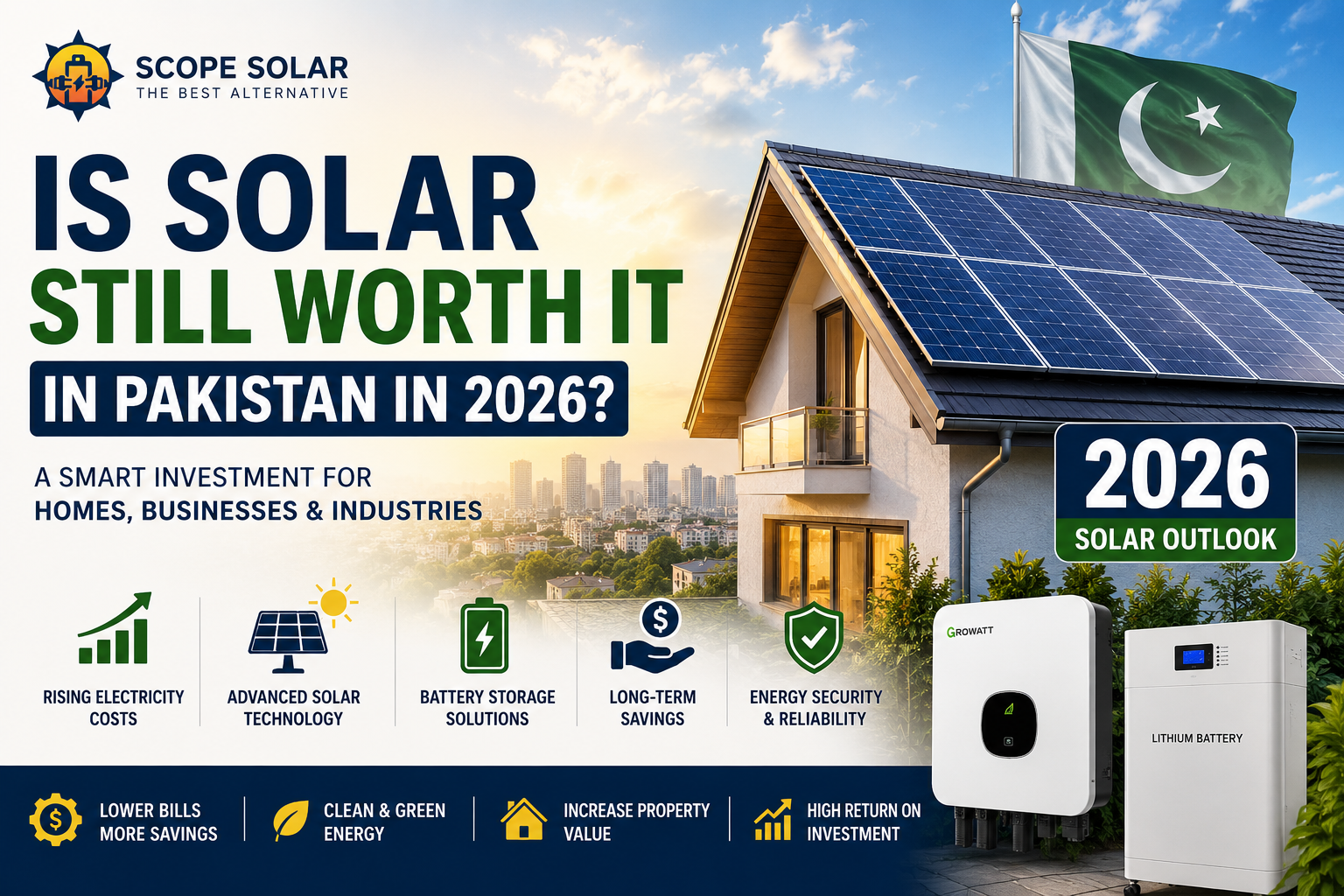
Pakistan’s energy landscape has changed rapidly over the last few years. Rising electricity costs, improved solar technology, falling equipment prices and growing interest in battery storage have encouraged thousands of homeowners and businesses to explore solar energy. However, in 2026, many people are asking an important question: Is solar still worth it in Pakistan?
Solar is no longer simply about installing panels on a rooftop. In 2026, homeowners and businesses need to consider their electricity consumption patterns, daytime usage, backup requirements, battery storage needs, roof space, equipment quality and long-term energy goals.
Pakistan’s solar market is also entering a new phase. The Competition Commission of Pakistan has highlighted the need for stronger quality standards, market transparency, better grid infrastructure and policy clarity as the country’s solar sector continues to expand.
So, before deciding whether to invest, let’s examine why solar can still be a valuable investment in Pakistan in 2026.
Better Solar Panel Technology in 2026
Solar technology has improved considerably and consumers now have access to more efficient panel options.
Modern N-Type technologies, including TOPCon, have become increasingly common in the market. These panels generally offer improved efficiency and performance characteristics compared with older-generation technologies. Some market reports indicate that newer technologies are becoming more accessible as solar equipment availability remains strong.
When planning to Buy Solar Panels for Home, homeowners should consider more than just the wattage printed on the panel.
Important factors include:
Panel Efficiency
Higher-efficiency panels can generate more power from limited roof space. This can be particularly useful for 5 Marla, 7 Marla and 10 Marla homes where rooftop space may be limited.
Temperature Performance
Pakistan experiences extremely high temperatures during summer. Since excessive heat can affect solar panel performance, choosing modern, high-quality technology can be beneficial for long-term energy production.
Product Authenticity
The Pakistani solar market contains a wide variety of imported equipment. Buyers should verify serial numbers, manufacturer information, warranty details and supplier credibility before purchasing.
Long-Term Warranty
A solar system is designed to operate for many years. Therefore, manufacturer warranties and the installer’s after-sales service should be considered before making a decision.
This is why choosing the right company for Solar Panels Installation Near Me is just as important as choosing the panels themselves.
Why Are People Still Choosing Solar in Pakistan?
The biggest reason remains simple: electricity is an essential and recurring expense.
Homes, offices, factories, shops, schools, hospitals and commercial buildings consume electricity every day. As electricity costs affect monthly operating expenses, consumers are increasingly looking for ways to produce and manage more of their own energy.
A properly designed solar system can help reduce dependence on expensive daytime electricity. However, the actual financial benefit depends heavily on when electricity is consumed.
For example, a home that uses air conditioners, appliances, pumps and other equipment during sunny hours may be able to use a significant portion of its solar production directly. Similarly, businesses that operate primarily during the day can often match solar generation with their operational demand.
Therefore, instead of asking only, “How many panels do I need?”, consumers in 2026 should ask:
- How many units of electricity do I consume every month?
- At what time do I consume the most electricity?
- How much of my consumption happens during daylight hours?
- Do I need power backup at night?
- Should I invest in battery storage?
- How quickly do I expect the system to recover its cost?
These questions can help determine whether a Hybrid Solar System for Home, commercial installation, or another configuration is the right solution.
Solar Equipment Prices Have Become More Attractive
One major reason solar remains attractive in 2026 is equipment pricing.
After concerns about possible new taxes on solar equipment before Pakistan’s 2026–27 budget, market prices reportedly fell when no additional taxes were introduced. Reports from June 2026 indicated declines in the prices of solar panels, lithium batteries and inverters as market supply improved and speculation eased.
However, solar prices can vary significantly depending on:
- Solar panel brand
- Panel technology
- Wattage
- Inverter brand and capacity
- Battery capacity
- Installation complexity
- Mounting structure
- Electrical protection equipment
- Warranty and after-sales support
For this reason, consumers should avoid choosing a system based only on the lowest quoted price.
A cheaper installation may use lower-quality protection devices, undersized cables, poor mounting structures, or equipment without reliable warranty support. Therefore, the Solar Installation Cost should be evaluated as a complete long-term investment rather than just comparing the price of solar panels.
The Growing Importance of Hybrid Solar Systems
One of the biggest changes in Pakistan’s solar market is the growing focus on energy storage.
The market is increasingly moving beyond simply generating electricity during sunlight hours. Consumers are becoming more interested in storing energy for use when solar production is low or unavailable.
Business Recorder’s research has also highlighted Pakistan’s shift toward energy storage as battery adoption grows and the solar market matures.
A Hybrid Solar System in Pakistan can combine solar panels, an inverter and battery storage to provide greater flexibility.
For homeowners, a hybrid system may offer benefits such as:
- Better utilization of solar energy
- Backup support during power interruptions
- Reduced dependence on electricity during selected hours
- Greater control over energy consumption
However, batteries increase the initial investment. Therefore, not every homeowner needs the largest battery available.
The correct battery size should be calculated according to essential loads and backup requirements. For example, a household may only need to support lights, fans, internet equipment, refrigerators and selected appliances during backup periods.
Oversizing the battery can unnecessarily increase the total project cost.
This is why professional energy assessment and system design are important before installing a Hybrid Solar System for Home.
Is Solar Worth It for Homes in Pakistan?
For many homeowners, solar can still be worth the investment in 2026, particularly when electricity consumption is high and a substantial amount of usage occurs during daytime hours.
However, the right system size is critical.
Installing an unnecessarily large system may increase the initial investment without providing proportional benefits. On the other hand, installing a system that is too small may fail to meet the household’s energy requirements.
A professional assessment should examine:
- Monthly electricity consumption
- Seasonal consumption changes
- Air conditioner usage
- Daytime electricity demand
- Roof orientation and shading
- Available installation area
- Future electricity requirements
- Backup requirements
For example, a household planning to purchase additional air conditioners or electric appliances in the future should consider those expected loads during the system design stage.
A properly planned system can therefore be more valuable than simply installing the maximum number of panels that can fit on the roof.
Is Solar Worth It for Businesses and Industries?
For commercial and industrial consumers, solar can be particularly valuable because many businesses consume significant electricity during daylight hours.
Factories, offices, warehouses, schools, hospitals and commercial facilities often operate when solar production is available. This can create a strong opportunity for direct solar energy consumption.
A well-designed Commercial Solar Energy Solutions project can help businesses manage operational electricity expenses and improve long-term energy planning.
Similarly, Industrial Solar Panel Installation requires a detailed engineering approach.
Before installation, a professional solar company should evaluate:
- Load profile
- Maximum demand
- Daytime consumption
- Roof structure
- Available space
- Future expansion
- Electrical infrastructure
- Safety requirements
The goal should not simply be to install more panels. Instead, the system should be designed around the facility’s actual energy requirements.
For companies searching for the Best Commercial Solar Systems, quality engineering, reliable equipment, electrical protection and after-sales maintenance can be more important than choosing the cheapest quotation.
Battery Prices Are Changing the Solar Decision
Lithium battery technology is becoming an increasingly important part of Pakistan’s solar market.
Reports following the 2026–27 budget indicated that lithium battery prices declined as market concerns regarding additional solar taxes eased.
Although batteries still represent a significant investment, improving availability can make energy storage more accessible to homeowners and businesses.
When choosing a battery, consumers should consider:
- Usable capacity
- Battery chemistry
- Cycle life
- Depth of discharge
- Warranty
- Compatibility with the inverter
- Future expansion options
- Safety features
LiFePO4 batteries are particularly popular because of their long cycle life and suitability for stationary energy storage applications.
However, consumers should not purchase batteries simply because they are the latest trend. Battery capacity should match the actual backup requirement.
Solar Is Not Automatically a Good Investment for Everyone
Although solar remains attractive, it is not automatically the right solution for every property.
For example, solar may be less suitable when:
- The roof receives significant shade
- The building has very low electricity consumption
- The roof structure cannot safely support the installation
- The property is temporary
- The consumer selects poor-quality equipment
- The system is incorrectly sized
This is why a site survey is essential.
A professional installer should inspect shading, roof orientation, structural conditions, cable routes, electrical panels and energy consumption before recommending a system.
Consumers should also be careful with unrealistic promises such as “zero bill guaranteed” or extremely short payback claims.
Solar performance depends on sunlight, weather, system design, equipment quality, electricity usage and maintenance.
Why Choosing the Right Solar Company Matters
A solar system is not just a collection of panels and an inverter.
The quality of installation can significantly affect system performance and safety.
When choosing a solar provider, customers should look for:
- Genuine equipment
- Clear product specifications
- Professional site surveys
- Proper system sizing
- High-quality mounting structures
- Electrical safety protection
- Experienced installation teams
- Warranty documentation
- After-sales support
Consumers searching for On Grid Solar solutions in Reasonable Price or other solar solutions should compare the complete system specifications rather than only comparing the total quotation.
A lower quotation may exclude important components or use lower-quality alternatives.
The Future of Solar in Pakistan
Pakistan’s solar market continues to evolve. The sector is moving toward higher-efficiency panels, smarter inverters, improved monitoring systems and greater use of battery storage.
The Competition Commission of Pakistan’s 2026 study also emphasized the importance of stronger market transparency, quality standards, investment and infrastructure improvements for the continued growth of the solar sector.
Meanwhile, the Power Division moved in April 2026 to seek removal of application fees and licensing requirements for solar consumers with systems of 25 kW or below, arguing that unnecessary procedural barriers could slow alternative energy adoption.
These developments show that solar energy remains an important part of Pakistan’s broader energy future.
Final Talk
Yes, solar is still worth considering in Pakistan in 2026 but the best investment is no longer simply the biggest solar system or the cheapest quotation.
Today, the value of solar depends on smart system design, direct energy usage, quality equipment and proper planning for future electricity needs.
Falling equipment prices, improved N-Type solar technology, smarter hybrid inverters and the growing availability of lithium battery storage have created new opportunities for homeowners and businesses. At the same time, buyers must carefully evaluate equipment quality, warranties, installation standards and their actual electricity consumption.
Whether you are looking to Buy Best Solar System Components, install solar for your home, or explore large-scale Commercial Solar Energy Solutions, the first step should always be a professional energy assessment.
At Scope Solar, the goal should be simple: design a solar solution around the customer’s actual energy requirements rather than offering a one-size-fits-all package.
Frequently Asked Questions (FAQs)
Is solar still profitable in Pakistan in 2026?
Solar can still provide significant long-term value, especially for properties with high electricity consumption and strong daytime energy usage. However, the financial outcome depends on system cost, electricity consumption, equipment quality and system design.
What type of solar system is best for a home in Pakistan?
The best system depends on electricity consumption, daytime usage, backup requirements, roof space and budget. A professional site survey can help determine the appropriate system size and configuration.
Are solar panel prices decreasing in Pakistan?
Solar market prices can change frequently due to imports, exchange rates, taxes, supply and demand. Reports in mid-2026 indicated that prices of panels, batteries and some inverters declined after the 2026–27 budget did not introduce additional solar equipment taxes.
Are hybrid solar systems worth buying in 2026?
A hybrid system can be valuable for consumers who want greater energy flexibility and backup capability. However, battery capacity should be selected according to actual energy requirements.
How do I choose a solar installation company in Pakistan?
Choose a company that provides a proper site survey, clear system specifications, genuine products, professional installation, electrical safety measures, documented warranties and reliable after-sales support.
Is solar suitable for commercial and industrial buildings?
Yes. Commercial and industrial properties with significant daytime electricity demand can benefit from properly designed solar systems. A detailed load analysis and engineering assessment should be completed before installation.
Should I choose the cheapest solar quotation?
Not necessarily. The cheapest quotation may use lower-quality equipment or exclude important components. Compare panel brands, inverter specifications, protection equipment, mounting structures, warranties and installation quality before making a decision.