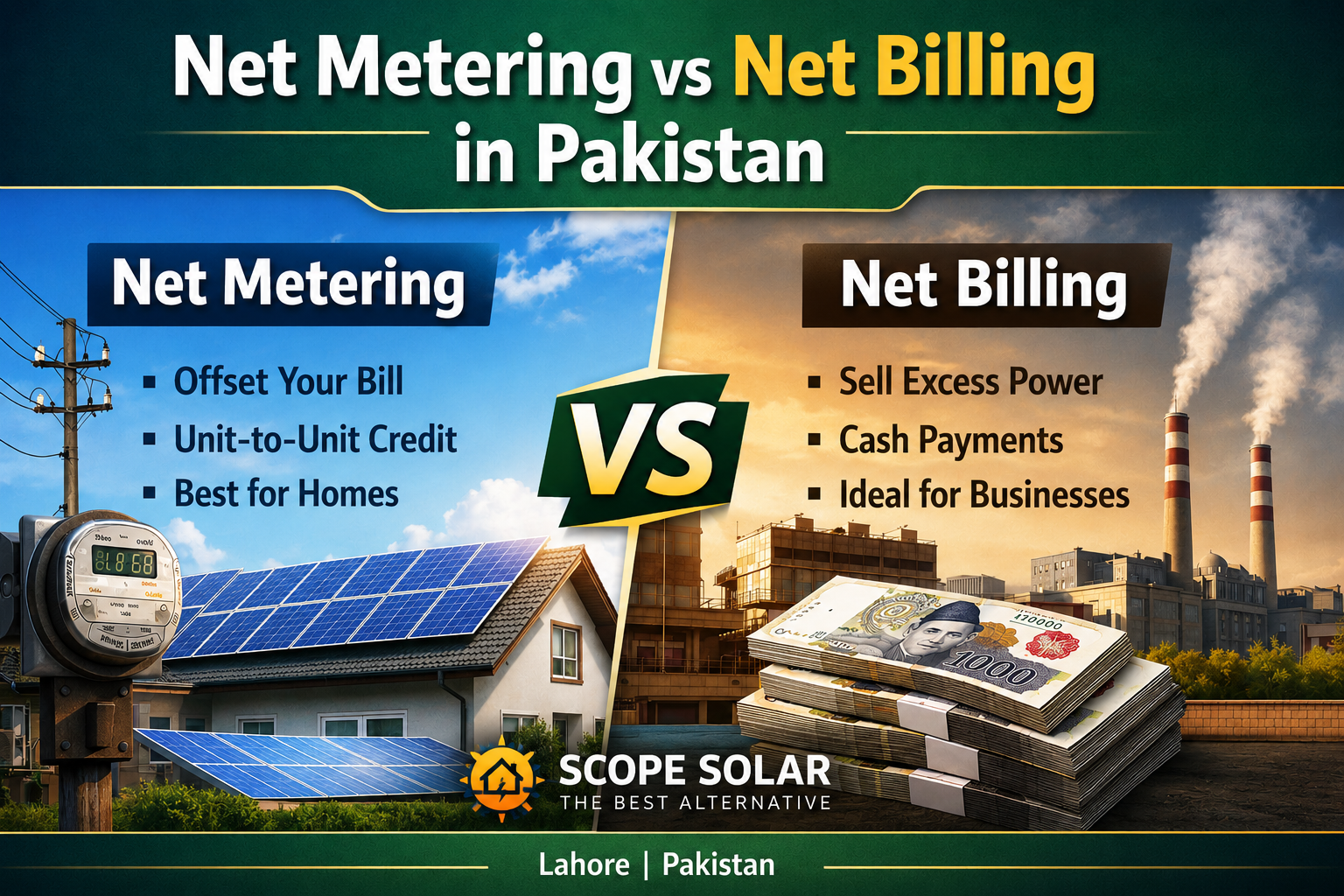
With rising electricity costs and frequent power shortages in Pakistan, solar energy has become a smart and long-term solution for homes and businesses. However, when installing a solar system, one important decision often creates confusion: Net Metering vs Net Billing.
Scope Solar regularly guide customers through this choice. This blog explains both systems in simple terms, highlights their differences, and helps you decide which option suits your energy needs best.
Why This Comparison Matters for Solar Users in Pakistan
Pakistan’s power sector policies allow solar users to export excess electricity to the national grid. However, how you are compensated for that excess energy depends on whether you are using net metering or net billing.
Choosing the wrong system can:
- Reduce your savings
- Increase your payback period
- Limit long-term benefits from your solar investment
Understanding the difference helps you maximize returns and reduce electricity bills effectively.
What Is Net Metering?
Net metering is a system where extra electricity produced by your solar panels is exported to the grid and adjusted against the electricity you consume from the grid.
In Pakistan, net metering is regulated by NEPRA and implemented through DISCOs like LESCO.
How Net Metering Works
- Solar panels generate electricity
- Your home uses solar power first
- Excess units are sent to the grid
- Exported units are deducted from imported units
- You pay the bill for net units consumed
Simple Example
If you consume 600 units in a month and export 400 units, you are billed for 200 units only.
What Is Net Billing?
Net billing is a different compensation method where exported electricity is sold to the grid for money, not adjusted in units.
Instead of reducing your bill units, exported energy is paid at a fixed, usually lower rate, while imported electricity is charged at the standard tariff.
How Net Billing Works
- Solar electricity powers your property
- Excess energy is exported
- You receive payment for exported units
- You pay full charges for imported electricity
- Final bill = electricity bill – export credit
Net Metering vs Net Billing (Comparison Table)
| Feature | Net Metering | Net Billing |
| Adjustment Method | Unit-to-unit | Cash-based |
| Export Rate | Same as import rate | Lower fixed rate |
| Monthly Bill Reduction | High | Moderate |
| Best For | Homes & small businesses | Large or commercial setups |
| Payback Period | Shorter | Longer |
| Availability in Pakistan | Widely available | Limited / policy-based |
Real-Life Examples (Pakistan Context)
Residential Example (Lahore Home)
- Monthly usage: 700 units
- Solar export: 450 units
Net Metering:
Bill charged for 250 units
Net Billing:
Bill charged for 700 units
Export paid separately at a lower rate
Net metering clearly offers higher monthly savings for homes.
Commercial Example
- Factory usage: High daytime consumption
- Solar production exceeds usage
In this case, net billing may still be viable if export volumes are very high, but savings depend on the export rate.
Pros and Cons of Net Metering
Advantages
- Maximum reduction in electricity bills
- Faster return on investment
- Simple billing structure
- Ideal for residential users
Limitations
- System size approval required
- Policy compliance with DISCO
- Export limits may apply
Pros and Cons of Net Billing
Advantages
- Suitable for large-scale generation
- Allows monetization of excess power
- Flexible for certain commercial setups
Limitations
- Lower export compensation
- Longer payback period
- Less attractive for homes
Which One Is Better for You?
Choose Net Metering if:
- You are a homeowner in Lahore
- Your goal is to reduce monthly bills
- Your consumption matches solar generation
- You want faster ROI
Choose Net Billing if:
- You produce much more electricity than you consume
- You operate a large commercial setup
- Export rates are financially viable
For most residential and small commercial users in Pakistan, net metering is the better option.
Cost, Savings & ROI Comparison
| Factor | Net Metering | Net Billing |
| Monthly Savings | High | Medium |
| Payback Period | 3–5 years | 5–7 years |
| Long-Term Benefit | Excellent | Moderate |
| Bill Stability | High | Variable |
At Scope Solar, we design systems that align with NEPRA regulations and your consumption pattern to ensure optimal ROI.
Common Myths About Net Metering & Net Billing
Myth: Net metering gives free electricity
Reality: It only offsets your consumption
Myth: Net billing always means profit
Reality: Export rates are usually lower
Myth: Both systems work the same
Reality: Billing structure and savings differ significantly
Frequently Asked Questions (FAQs)
Is net metering allowed in Pakistan?
Yes, net metering was allowed in Pakistan.
It was approved by NEPRA and available through DISCOs like LESCO. But Net metering is currently paused due to government and NEPRA policy decisions, as authorities are considering and moving towards a shift from net metering to net billing.
However, from 15 December 2025, the policy has shifted from net metering to net billing.
Can I switch from net billing to net metering?
Yes, subject to policy approval and system compliance.
Which option gives more savings?
Net metering offers higher savings for most users.
Does Scope Solar handle approvals?
Yes, we assist with documentation, installation, and net metering approval.
Final Thoughts
Choosing between net metering and net billing can directly impact your solar savings. For most homeowners and small businesses in Lahore, net metering remains the most cost-effective and reliable option.
If you’re planning a solar installation or need expert advice, Scope Solar is here to guide you with transparent solutions and professional support.
Contact Scope Solar today to find the best solar solution for your energy needs.