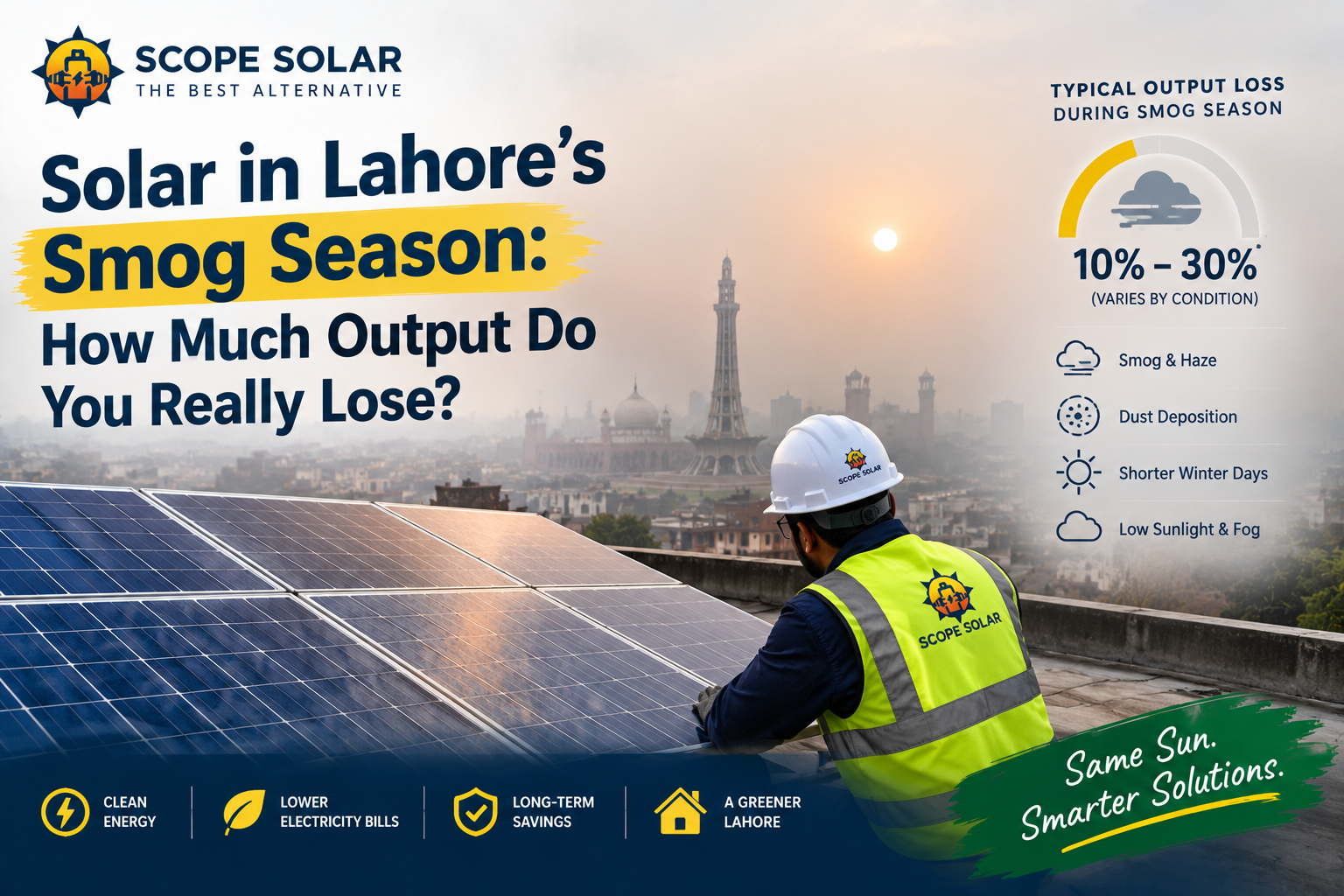
Solar in Lahore’s Smog Season | How Much Output Do You Really Lose?
Lahore’s smog season can create challenges for homeowners and businesses that rely on solar energy. During autumn and winter, haze, airborne dust, pollution, fog, and reduced sunlight can affect how much electricity rooftop solar panels generate. As a result, many solar owners wonder whether their systems are still performing properly when the sky looks grey.
The important point is that smog does not affect solar production in just one way. Airborne particles can reduce the sunlight reaching solar panels, while dust and pollution that settle on the panel surface can block additional sunlight. Shorter winter days and low-angle sunlight can also reduce daily generation.
So, how much output can you really lose during Lahore’s smog season? The answer depends on air quality, weather, panel cleanliness, system orientation, and the amount of sunlight available. In this guide, we explain the main causes of reduced solar generation, how to estimate potential losses, and what homeowners can do to keep their systems performing efficiently.
1. How Much Solar Output Do You Lose During Lahore’s Smog Season?
There is no scientifically reliable single percentage that applies to every solar system in Lahore. Losses vary according to the severity of atmospheric pollution, the amount of dust on the panels, rainfall, panel tilt, and the amount of sunlight available.
Research on photovoltaic systems shows that both airborne pollution and particles deposited on panel surfaces can reduce energy generation. A review published in Renewable and Sustainable Energy Reviews explains how airborne pollution reduces incoming solar radiation, while accumulated dust creates an additional layer that blocks sunlight.
Here is a practical guide to understanding the different types of loss:
| Factor | Effect on Solar Production |
| Smog and atmospheric haze | Less sunlight reaches the panels |
| Dust and pollution on panels | Less light passes through the glass |
| Shorter winter days | Fewer potential hours of solar generation |
| Heavy cloud or fog | Lower sunlight intensity during affected periods |
| Shading or equipment faults | Additional losses unrelated to smog alone |
Important: The following are different problems. A system may produce less electricity in December than in May because winter days are shorter and the sun follows a different path. That does not mean smog alone caused the entire reduction.
A reliable estimate requires comparing your system’s actual production with its expected output under similar weather and seasonal conditions.
2. Why Does Lahore’s Smog Reduce Solar Generation?
Atmospheric Haze Blocks and Scatters Sunlight
Solar panels generate electricity when sunlight reaches their photovoltaic cells. During severe smog, airborne particles scatter and absorb some of the incoming sunlight.
As a result, less direct sunlight may reach the panels. Diffuse sunlight can still contribute to generation, so solar panels do not necessarily stop working when the sky looks grey.
The effect depends on how dense the haze is, how long it lasts, and the amount of sunlight available before and after the pollution episode.
Dust and Pollution Accumulate on Panel Surfaces
Lahore’s urban environment can expose rooftop panels to road dust, construction particles, industrial pollution, and other airborne material.
When these particles settle on the glass, they reduce the light reaching the solar cells. This is known as soiling loss.
A review of research into dust accumulation found that losses vary substantially by climate and location, with severe cases in dry and dusty environments. It also highlights the importance of rainfall, cleaning frequency, and panel installation angle.
Fog and Low Sunlight Can Compound the Problem
Winter mornings can bring fog or dense haze, delaying the time when panels receive strong sunlight. If conditions remain poor, the system may experience lower output for several hours.
Therefore, a smoggy winter day can combine reduced sunlight intensity, fewer productive hours, and surface contamination.
3. What Research Says About Solar Panel Pollution in Lahore
Local research is particularly useful because solar panel performance depends on the surrounding environment.
A review of photovoltaic soiling research reports findings from a Lahore study by Ullah and colleagues, which examined pollution-related output loss at different panel inclinations over 120 days. The review describes substantial differences in reported daily losses depending on panel angle.
However, these figures should not be treated as a guaranteed loss rate for every Lahore rooftop. Results from a particular experiment depend on its location, exposure period, panel technology, cleaning conditions, and measurement method.
For a homeowner or business, the most useful approach is to measure the actual system and compare its performance over time.
4. Why Your Solar System Produces Less Electricity in Winter
Smog is only one reason for lower winter generation. Three seasonal factors deserve particular attention.
Shorter Days
In winter, Lahore has fewer daylight hours than during late spring and summer. This reduces the time available for solar generation.
Even on a relatively clear winter day, a system may generate fewer total units than it would during a long summer day.
Lower Sun Angle
The sun follows a lower path across the sky in winter. Depending on the panel orientation and tilt, this can change how much sunlight the array receives throughout the day.
A well-designed system accounts for the site’s location and expected seasonal sunlight when determining panel placement.
Weather Variability
Clouds, fog, rain, and atmospheric haze can change from one day to another. Consequently, comparing a sunny day in October with a heavily polluted day in December will not provide a fair measurement of smog-related losses.
The best comparison is between similar days, with similar system conditions, while accounting for seasonal changes.
5. How Can You Calculate Your Solar Output Loss?
You can estimate your system’s performance by comparing its actual production with the amount it would reasonably be expected to generate under similar conditions.
Use this simple formula:
For example, suppose your monitoring system indicates that your panels should have generated 20 units on a particular day, after accounting for the weather and season. Instead, they generate 17 units.
Your estimated output shortfall is:
This represents a 15% shortfall against the estimated benchmark. It does not prove that smog caused the entire loss. Dirty panels, shading, inverter limitations, or inaccurate forecasts may also contribute.
To make the comparison more reliable:
- Review daily generation in your inverter monitoring app.
- Compare similar days rather than summer and winter totals.
- Check whether the panels have accumulated dust.
- Look for inverter warnings or unexpected shutdowns.
- Compare the system’s output before and after safe panel cleaning.
- Ask a solar professional to investigate persistent unexplained losses.
6. How to Reduce Solar Losses During Lahore’s Smog Season
You cannot control Lahore’s air quality, but you can reduce some of the losses caused by dirt and poor maintenance.
Clean Solar Panels When Necessary
Panel cleaning is one of the most practical ways to address surface contamination.
Inspect your panels periodically during the smog season. If a visible layer of dust or grime has accumulated, arrange appropriate cleaning according to the manufacturer’s instructions.
Use suitable water and a soft, non-abrasive cleaning method. Avoid harsh chemicals, abrasive brushes, and high-pressure cleaning that could damage the panels.
For safety, do not climb onto roofs or clean panels during rain, strong winds, or when electrical equipment is exposed. Consider hiring a professional cleaning team for difficult-to-access installations.
Check Panels After Rain
Rain may remove some loose dust, but it does not always eliminate sticky pollution residue or dirt deposits. After rainfall, inspect the panels when it is safe to do so.
If the glass remains visibly dirty, additional cleaning may be necessary.
Research reviews identify rainfall as an important natural cleaning mechanism, although its effectiveness varies with rainfall intensity, dust composition, and local conditions.
Monitor Daily Energy Generation
Modern solar inverters often provide monitoring apps that display daily generation, historical performance, and system alerts.
Use these tools to establish a normal production pattern for your installation. A gradual decline during hazy weather may reflect environmental conditions, while a sudden and persistent drop could indicate a technical issue.
Inspect Wiring and Inverter Performance
Smog does not explain every production problem.
If output remains unusually low after the weather improves and the panels are clean, check the inverter’s status and consult a qualified technician. Loose connections, damaged cables, shading, and equipment faults can also reduce generation.
Keep Nearby Shading Under Control
Trees, new construction, rooftop water tanks, and other obstructions can cast shadows across solar panels.
Check for new shading during winter, when the sun’s lower path can change how shadows fall on the array.
7. Does Smog Make Solar Power a Bad Investment in Lahore?
No. Seasonal reductions in solar generation do not automatically make solar power a poor investment.
Solar panels can continue generating electricity during hazy conditions, although their output may be lower than on clear, sunny days. The long-term value of a solar installation depends on annual generation, equipment quality, electricity consumption, installation costs, and ongoing maintenance.
For homeowners planning to Buy Solar Panels for Home, it is important to choose a system based on annual energy requirements rather than assuming the same daily production throughout the year.
Businesses should take a similar approach when evaluating Commercial Solar Energy Solutions. A professional installer can assess the property’s energy usage, roof conditions, seasonal sunlight, and equipment requirements.
The objective is not to eliminate every seasonal fluctuation. It is to design a system that performs reliably across the year.
8. Choosing the Right Solar System for Lahore’s Conditions
A well-designed system can help you manage the effects of dust, pollution, and seasonal weather.
When evaluating Solar Installation Cost, consider more than the price of the panels. The quality of the inverter, mounting structure, electrical protection, monitoring system, and installation workmanship can influence long-term performance.
Here are some important considerations:
- High-efficiency panels: Useful when rooftop space is limited.
- Correct panel positioning: Helps maximize sunlight exposure throughout the year.
- Suitable mounting structures: Provide secure support and allow appropriate access for maintenance.
- Reliable inverter monitoring: Helps identify performance changes and faults.
- Regular maintenance: Reduces avoidable losses caused by dirt and equipment problems.
- Professional site assessment: Helps identify shading and other location-specific challenges before installation.
For industrial facilities, Industrial Solar Panel Installation requires additional attention to energy demand, roof structure, electrical design, and operating schedules.
Scope Solar can assess these factors when planning residential, commercial, and industrial solar projects in Lahore and other parts of Pakistan.
Final Thoughts
Lahore’s smog season can reduce solar electricity generation, but there is no single percentage that accurately describes the loss for every installation. Atmospheric haze reduces the sunlight reaching the panels, while dust and pollution deposited on their surfaces can create additional losses.
Winter also brings shorter days, a lower sun angle, and variable weather. These factors can combine to make solar production noticeably lower than it was during summer.
The best approach is to monitor your system, keep panels reasonably clean, investigate unexpected performance drops, and compare production against realistic seasonal expectations.
With appropriate design and maintenance, solar panels can remain a valuable source of electricity throughout Lahore’s changing weather conditions.
FAQs
How much solar output is lost during Lahore’s smog season?
There is no universal percentage. Losses depend on atmospheric haze, surface dust, weather, panel angle, and the condition of the system. Compare actual generation with a suitable weather-adjusted benchmark to estimate the shortfall.
Do solar panels work during smog?
Yes. Solar panels can still generate electricity during smog because some sunlight reaches the cells. However, output may decrease when atmospheric pollution significantly reduces incoming sunlight.
Does cleaning solar panels improve winter generation?
Cleaning can recover some of the electricity lost because of accumulated dirt. It cannot remove losses caused by shorter days, dense haze, or other weather conditions.
How often should solar panels be cleaned in Lahore?
There is no fixed schedule for every rooftop. Inspect the panels regularly and clean them when significant dirt accumulates, taking local conditions and manufacturer recommendations into account.
Why is my solar system producing fewer units in December than in summer?
Shorter daylight hours, the lower winter sun angle, clouds, fog, smog, and dirty panels can all contribute to lower production. A technical inspection may be needed if the reduction is unusually large.
Can a solar monitoring app identify smog-related losses?
Monitoring apps show actual production and can help identify unusual patterns, but they do not always separate smog losses from dust, weather, shading, or equipment problems.
Should I install solar in Lahore despite seasonal smog?
Solar can still be a practical long-term investment. Assess annual energy needs, expected generation, equipment quality, installation costs, and maintenance requirements before deciding.