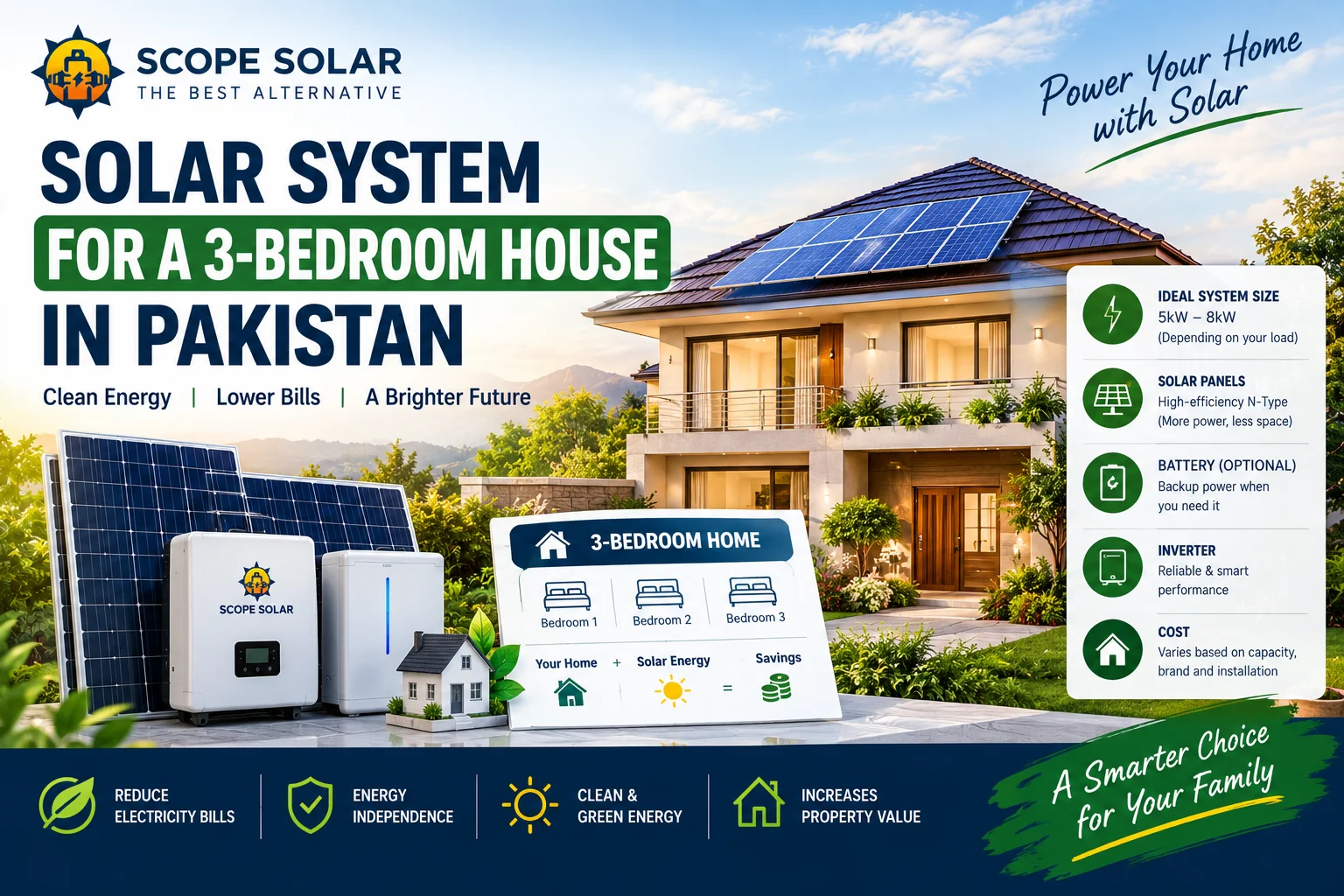
Solar energy has become an increasingly practical choice for homeowners in Pakistan. Rising electricity costs, frequent power interruptions and the availability of more efficient solar technology have encouraged many families to consider installing solar systems for their homes.
For a typical 3-bedroom house in Pakistan, the right solar system depends less on the number of bedrooms and more on the home’s electricity consumption. Appliances such as air conditioners, refrigerators, water pumps, washing machines, televisions, fans and kitchen equipment can significantly change the required system size.
In many cases, a 5kW to 8kW solar system can be a suitable starting range for a 3-bedroom home. However, a professional load assessment should always be completed before making a final decision.
What Size Solar System Does a 3-Bedroom House Need?
There is no single solar system size that works for every 3-bedroom house. Two homes with the same number of bedrooms can have completely different electricity requirements.
For example, a house using fans, lights, a refrigerator, water pump and basic appliances may require a smaller system. In contrast, a home operating multiple air conditioners, heavy kitchen appliances and other high-power equipment may require considerably more capacity.
A general starting guide is:
| Solar System Size | Typical Use |
| 3kW | Basic household loads |
| 5kW | Medium residential electricity usage |
| 6kW | Medium-to-high household consumption |
| 8kW | Higher loads, including multiple appliances |
| 10kW | Large consumption or higher future requirements |
Therefore, homeowners should not choose a system simply because it is advertised as suitable for a particular house size.
Is a 5kW Solar System Enough for a 3-Bedroom House?
A 5kW system can be a good option for many 3-bedroom homes, particularly when electricity usage is moderate.
A typical 5kW system may include high-efficiency solar panels, a 5kW inverter, mounting structures, protection equipment, wiring and installation.
However, the actual performance depends on how the electricity is consumed.
For example, if a home regularly operates:
- 1–2 air conditioners
- Refrigerator
- Water pump
- Washing machine
- Fans
- LED lights
- Television
- Internet equipment
- Kitchen appliances
the installer should calculate the combined load and daily energy consumption before recommending 5kW.
For homeowners planning to Buy Solar Panels for Home, this assessment is one of the most important steps.
When Should You Choose a 6kW or 8kW System?
A 6kW or 8kW system may be more appropriate when a 3-bedroom house has higher electricity consumption.
You may need a larger system if your home regularly uses several air conditioners, electric water heaters, large refrigerators, pumps, or other high-consumption appliances.
A larger system can also make sense when you expect your electricity requirements to increase in the future.
For example, a homeowner may currently operate two air conditioners but plan to add another AC or electric vehicle charger later. Designing the system with future requirements in mind can prevent unnecessary upgrades.
How Many Solar Panels Are Required?
The number of panels depends on the wattage of the selected modules.
For example, using approximately 585W panels:
- A 3kW system may require around 6 panels
- A 5kW system may require around 9 panels
- A 6kW system may require around 11 panels
- An 8kW system may require around 14 panels
- A 10kW system may require around 17 panels
Actual panel counts can vary because system capacity, panel wattage, inverter specifications, available roof space and design requirements all affect the final configuration.
Modern N-Type panels, including TOPCon-based modules, are increasingly attractive because their high efficiency can help produce more power from limited roof space.
What Components Are Needed for a Home Solar System?
A complete residential solar installation requires more than solar panels.
A typical system includes:
Solar Panels
Solar panels convert sunlight into DC electricity. Choosing reliable, high-efficiency panels can improve energy production and long-term value.
Solar Inverter
The inverter converts DC electricity from the panels into usable AC electricity for household appliances.
Modern inverters can also provide monitoring features, multiple MPPTs and compatibility with battery storage.
Mounting Structure
The structure securely holds the panels on the roof. It should be strong, corrosion-resistant and properly designed for the property.
Electrical Protection
Proper protection equipment helps protect the solar system and household electrical infrastructure from electrical faults and other risks.
Solar Cables and Connectors
High-quality cables and compatible connectors are essential for safe and reliable energy transfer.
Battery Storage
A battery is optional, but it can be valuable for homeowners who want backup power and greater control over their energy usage.
This makes a Hybrid Solar System for Home particularly useful for households that want solar generation combined with battery storage.
Should a 3-Bedroom House Choose an On-Grid or Hybrid System?
The right system type depends on your energy requirements and backup expectations.
On-Grid Solar System
An on-grid system primarily uses solar generation during the day and is generally suitable for households that want to reduce their dependence on conventional electricity.
It can be a practical choice when most electricity consumption occurs during daylight hours.
Hybrid Solar System
A hybrid system combines solar panels with battery storage. This allows the household to store energy for later use and provides greater flexibility during power interruptions.
A hybrid system can be particularly useful for families that want backup power for essential appliances such as:
- Fans
- Lights
- Refrigerator
- Wi-Fi router
- Television
- Selected kitchen appliances
The battery should be sized according to the loads you actually want to operate during backup periods.
Solar System Cost for a 3-Bedroom House
The Solar Installation Cost for a 3-bedroom house varies considerably depending on system capacity and equipment selection.
As a general 2026 market indication, residential systems can fall into different price ranges depending on whether they are installed without battery storage or as hybrid systems with lithium batteries.
For example, a smaller 5kW system may cost substantially less than an 8kW system with a large battery bank.
The final quotation depends on:
- Solar panel brand
- Panel wattage and technology
- Inverter brand
- Battery capacity
- Battery chemistry
- Mounting structure
- Electrical protection
- Roof complexity
- Installation requirements
- System monitoring
- Warranty and after-sales service
Therefore, homeowners should request a complete itemized quotation rather than comparing only the total price.
How Much Roof Space Is Required?
Roof space is another important consideration.
High-wattage panels can help reduce the number of modules required for a particular system size. However, the actual space requirement depends on panel dimensions, spacing, roof layout, shading, maintenance access and mounting configuration.
Before installation, the installer should inspect the roof and determine the best panel arrangement.
This is particularly important for urban homes where neighboring buildings, water tanks, boundary walls and other structures can create shading.
How to Calculate Solar Requirements for Your Home
Before choosing a solar system, start by reviewing your electricity consumption.
Make a list of major appliances and estimate how many hours they operate each day.
For example:
| Appliance | Typical Consideration |
| Air Conditioner | High energy consumption |
| Refrigerator | Continuous/regular operation |
| Water Pump | Short but high-power operation |
| Fans | Multiple units may operate together |
| Washing Machine | Periodic usage |
| Lights | Generally lower consumption |
| Television | Moderate consumption |
| Kitchen Appliances | Usage varies significantly |
A professional installer can then use this information to calculate the required capacity.
This approach is much more accurate than selecting a system based only on the size of the house.
Common Mistakes to Avoid
Homeowners should avoid several common mistakes when installing solar.
Choosing a System Without Load Assessment
A system that is too small may not meet your requirements, while an unnecessarily large system can increase your investment.
Selecting Equipment Only Because It Is Cheap
The cheapest panels or inverter may not provide the best long-term value. Always consider quality, efficiency, warranty and manufacturer support.
Ignoring Roof Shading
Even partial shading can affect solar production. The installer should inspect the property throughout the day.
Using Poor-Quality Wiring
Improper cables, connectors and electrical protection can create performance and safety problems.
Ignoring Battery Requirements
If backup power is important, battery capacity should be calculated according to the appliances you want to operate and the expected backup duration.
Hiring an Installer Without Checking Experience
Installation quality can significantly influence system performance. Always evaluate the installer’s experience, equipment specifications, warranty and after-sales service.
Why Professional Installation Matters
A solar system is a long-term investment, so proper design and installation are essential.
A professional solar company should normally follow a process that includes:
- Electricity load assessment
- Site inspection
- Roof and shading analysis
- System design
- Equipment selection
- Detailed quotation
- Professional installation
- Electrical testing
- System commissioning
- Monitoring and after-sales support
For homeowners searching for Solar Panels Installation Near Me, choosing an experienced installer can help avoid costly mistakes and improve the long-term reliability of the system.
Choosing the Right Solar Solution for Your 3-Bedroom House
The best solar system for a 3-bedroom house depends on your actual electricity usage rather than the number of bedrooms alone.
For moderate consumption, a 5kW system may be sufficient. Homes with higher electricity usage may benefit from 6kW, 8kW, or even larger systems.
If you want battery backup, a properly designed Hybrid Solar System in Pakistan can provide additional flexibility. Meanwhile, homeowners interested in Residential Off grid solar solutions may require a more comprehensive battery-based design depending on their energy requirements.
The goal should always be to create a balanced system where the panels, inverter, battery, electrical protection and mounting structure work together efficiently.
Final Thoughts
A Solar System for a 3-Bedroom House in Pakistan can be an excellent long-term investment when it is properly designed and installed. However, there is no universal system size for every home.
A 5kW system may work well for moderate consumption, while homes with multiple air conditioners and heavier appliances may require 6kW, 8kW, or more.
Before making your decision, evaluate your electricity consumption, available roof space, future requirements, battery needs, equipment quality and installation standards. Most importantly, choose a professional solar installer that can perform a proper site survey and provide a system designed around your household’s actual requirements.
FAQs
What is the best solar system size for a 3-bedroom house in Pakistan?
A 5kW to 8kW system can be a suitable range for many 3-bedroom homes, but the correct size depends on actual electricity consumption.
How many solar panels are needed for a 5kW system?
With approximately 585W panels, a 5kW system may require around 9 panels. The exact configuration depends on the selected equipment and system design.
Is a hybrid solar system suitable for a 3-bedroom house?
Yes. A hybrid system can be useful for homeowners who want solar generation along with battery storage and backup power.
How much does a solar system cost for a 3-bedroom house?
Cost depends on system capacity, panel and inverter brands, battery size, installation requirements and other components. A professional quotation is needed for an accurate figure.
Do I need batteries for my home solar system?
Not necessarily. Battery requirements depend on your backup needs, energy consumption pattern and the type of solar system you choose.
Can a 5kW solar system run air conditioners?
It can support air conditioners depending on their capacity, number, operating hours and the other loads running at the same time. A professional load calculation should be performed before installation.